- Aerial, is a type of photography that uses airborne device or means of transportation such as plane, helicopter, balloon, kite and the like.
- Animal, for the pet-lovers who want to take pictures of their irresistible pets.
- Architectural, sometimes panoramic photos of structures to promote its beauty.
- Black and White, a popular type that deals with shadows and highlights to give a dramatic effect on the composition.
- Landscape, type that gives attention to the natural wonders of the Earth. From breath-taking views of the mountains to the beautiful sunset at the beach.
- Macro, emphasizes objects with fascinating views of a close-up subject. Its scale can be full-size of 1:2.
- Night, focuses on the attractiveness of city skylines during the night time wherein lights are abundant on structures. And it also captures fireworks, and scenery of the evening.
- Panoramic, a type that produce a photo similar to what the human eyes can see. It can also be a picture showing the complete 360 degrees of the scenery.
- Portrait, its goal is to create an atmosphere of the personality of the subject or a group of subject, whether it is a person, a pet, or a team.
- Sports, often used for journalism or to capture a subject that is engaging in sports, games, or adventures.
- Time-Lapse, is a photograph with very long exposure that is to illustrate what happens over time. One example is a street at night with car lights blurred into long lines that creates a streaking line across the photo.
- Underwater, focuses on the use of water-tight camera housing to produce photographs of the marine world.
Friday, February 26, 2010
Types of Photography
There are different types of photography depending on the subject, location, purpose or the photographer's preferences. These are some of the most common types of photography.

Saturday, February 20, 2010
Guide to Photography: Part 2
Now you are ready for a more deep understanding of photography. First off, you need to know the basics in composition.
Next is simplicity of the composition, we know that minimalism is one of the most popular style of art because it is directness. The fourth principle is symmetry, whether symmetrical or asymmetrical, it gives the viewer a distinct balance of the photo. Lighting is one of the most important principle. There are different types of techniques related to lighting, such as the use of shadows, silhouettes, etc.
After learning about the principles in composition, know what type of photographs you are going to take. There are different techniques for different subjects.
Previous
Principles of composition
The first principle is the point of interest, as discussed in the rule of thirds, this is the point wherein the subject attracts the viewer's eyes. It is basically the main focus of the photo. Related to the first principle is the principle of placing the subject off-center to give a strong relationship between the background and the foreground.Next is simplicity of the composition, we know that minimalism is one of the most popular style of art because it is directness. The fourth principle is symmetry, whether symmetrical or asymmetrical, it gives the viewer a distinct balance of the photo. Lighting is one of the most important principle. There are different types of techniques related to lighting, such as the use of shadows, silhouettes, etc.
After learning about the principles in composition, know what type of photographs you are going to take. There are different techniques for different subjects.
Basic Photography Techniques
The techniques I will discuss would be useful for beginners and amateurs as it is fairly easy to understand.- Afocal photography, this technique uses optical telescope or microscope to create an effect of close-up without the use of the built in zoom. This technique usually use point-and-shoot cameras because of its lightweight and less bulky structure, compared to a much larger SLR.
- Bokeh, originated in Japan that means blur. This technique uses small F-Stop which primarily is needed to blur the background, if a subject is present, or blur the entire view.
- Contre-jour, is a French term meaning against daylight. It uses daylight or other form of light source as backlighting to produce silhouettes of the subject.
- Fill flash uses the aperture and shutter speed in correct exposure for the background while the flash fills in foreground to produce equal lighting for both background and foreground.
- Fireworks photographs is one of the most interesting techniques. It makes use of long exposure to capture the fireworks from when it goes up until it explodes.
- Night photography is particular to photos taken between dusk and dawn with the use of artificial lighting or long exposure. This type usually is for city skylines or areas with beautiful night lights.
Previous
Friday, February 19, 2010
Guide to Photography: Part 1
I will be writing this guide to give information on photography. This guide will be a reference to beginners and amateurs, but can be helpful for experienced photographers.
First off, knowing your reason in taking pictures is a must. Are you taking pictures as a hobby?, or do you like taking pictures for storing perfect memories?, and so on. After you have chosen your preference, you will need to know what camera type fits for you.
Types of Cameras
As you would have read, a Point and Shoot (or P&S) camera is suitable for people who capture for keeping memories while a Single Lens Reflex (SLR) camera would be more appropriate for a hobbyists and professionals. After choosing a type, you have to choose your brand. Personally, I had tried only a few cameras, a Canon EOS30D, Canon EOS450D, a Canon Powershot and Kodak Easyshare (can't remember both of the models though). As you can see, I have yet to try Nikon DSLRs. Anyway, I stumbled upon this article comparing Canon and Nikon DSLRs, Canon vs Nikon Digital SLR Cameras.
After reading the comparison, you must get to know your camera. Read the manual included in the package, it will help a lot. And also, getting familiar with the terms will let you understand the functions. Here's a list of terms, Important Terms in Photography. These are the basics in photography jargon. From then on I will refer to the terms I mentioned above. Try out what you have learned and put it in to practice. "Practice makes perfect".
Next
First off, knowing your reason in taking pictures is a must. Are you taking pictures as a hobby?, or do you like taking pictures for storing perfect memories?, and so on. After you have chosen your preference, you will need to know what camera type fits for you.
Types of Cameras
As you would have read, a Point and Shoot (or P&S) camera is suitable for people who capture for keeping memories while a Single Lens Reflex (SLR) camera would be more appropriate for a hobbyists and professionals. After choosing a type, you have to choose your brand. Personally, I had tried only a few cameras, a Canon EOS30D, Canon EOS450D, a Canon Powershot and Kodak Easyshare (can't remember both of the models though). As you can see, I have yet to try Nikon DSLRs. Anyway, I stumbled upon this article comparing Canon and Nikon DSLRs, Canon vs Nikon Digital SLR Cameras.
After reading the comparison, you must get to know your camera. Read the manual included in the package, it will help a lot. And also, getting familiar with the terms will let you understand the functions. Here's a list of terms, Important Terms in Photography. These are the basics in photography jargon. From then on I will refer to the terms I mentioned above. Try out what you have learned and put it in to practice. "Practice makes perfect".
Next
Important Terms in Photography
Aperture
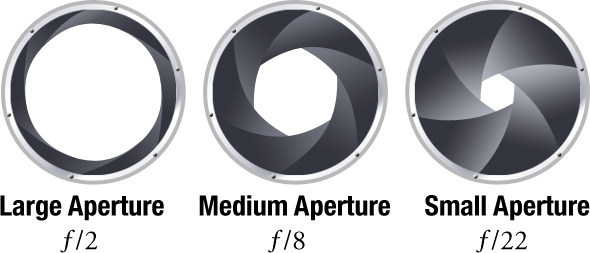
Aperture is one of the most confusing aspects of photography.It is an adjustable opening inside the camera lens that works very similar the iris in your eye. When the aperture wide, more light is allowed through the lens to expose the film or image sensor. When the aperture is narrow, less light reaches the film or image sensor. Aperture works in conjunction with shutter speed and film speed or ISO to determine the total amount of light that reaches the film. Aperture size also affects depth of field. A representation of aperture is found below.
Depth of Field
Depth of Field, or DOF, explains how deep the focus is within an image and is controlled by the aperture/F-Stop. Images with a large amount of the image in focus are said to have a large depth of field while images with only one small part in focus are said to have a small depth of field. This does not affect the side to side focus of the image, only the depth. A small DOF is more appropriate for a macro or close-up, and portraits, while a large DOF is applicable to landscape photographs.Shutter Speed
Shutter speed is one of the most important controls on a camera. Shutter speed controls the amount of time that your film, or digital sensor, is exposed to light. The shutter is opened when you press the shutter release button on your camera to take a picture. The shutter speed determines how long the shutter remains open.
In cameras with TTL (through the lens) viewfinders, the shutter release button also moves a mirror out of the way of the film and shutter curtain. The movement of the shutter curtain and the mirror that gives taking a picture its distinctive "click" sound. It is similar to the pinhole camera wherein the photographer exposes the paper and close the pinhole to create a picture. The representation below shows how the shutter works.

ISO
The ISO speed is a measure of the film speed, or its sensitivity to light. With digital cameras the ISO affects the sensor instead of the film, but the principal is the same. A low ISO speed requires a longer exposure or more light while a high ISO speed requires less time to give the same exposure or less light On 35mm film, a film with high ISO speed had much more grain than a slower film — but the modern sensors don’t create the same grain with high ISO speeds. Instead it creates noise. Use a low ISO speed if light is abundant while use a high ISO speed if indoors or bad lighting.
Rule of Thirds
The basic principle behind the rule of thirds is to imagine breaking an image down into thirds, both horizontally and vertically, so that you have 9 parts. As the image shows.

The theory is that if you place the subject in the points of interest, the intersections of vertical and horizontal lines, that your photo becomes more balanced and will attract the viewer of the image to the subject. Studies have shown that when viewing images, people’s eyes usually go to one of the intersection points most naturally rather than the center. Using the rule of thirds works with this natural way of viewing an image rather than working against it.
Types of Cameras
Point-and-Shoot
Description
Point-and-shoot cameras literally mean that point the camera at something and push the shutter. The camera does all the adjustments for you. These cameras started out as a fixed lens that focused about 4 feet in front of the camera with a fixed aperture and shutter speed. Today's P&S cameras are much more sophisticated. At present, most P&S are digital though some still manufacture disposable or film cameras.
Features
Point-and-Shoot (P&S) cameras has limited controls such as automatic focus, variable shutter speed, variable aperture. It has a built-in flash for lighting purposes. P&S cameras use metering systems, which calculate the amount of light entering the camera and preset controls for situations such as landscapes, nighttime, people, macro, and many more depending on the manufacturer.
The biggest drawback to P&S cameras is that it does not give you the What You See Is What You Get (WYSIWYG) type of picture. This means that what you see through your viewfinder may not be what you capture on film or digital media. P&S cameras are usually small and fit into a pocket or purse and are best used for casual picture taking where capturing the memory is more important than capturing a profitable image.
SLR and DSLR
Description
SLR stands for Single Lens Reflex and DSLR stands for Digital Single Lens Reflex and refers to how the light enters the camera. SLR is a camera that uses a semi-automatic moving mirror system which permits the photographer to get a photo of what he sees in the viewfinder. These cameras have a larger body than most P&S cameras and interchangeable lenses. While SLRs started out a fully manual, where the photographer had to control all features including focus, most of these cameras are capable of acting in a fully automatic mode just like a P&S.
Features
SLRs and DSLRs lets you control shutter speed, aperture, film speed or ISO, focus point, optical zoom, add-on flash, remote releases, and rechargeable battery packs.
Subscribe to:
Posts (Atom)
.jpg)

